How AI Decides Which Businesses to Recommend
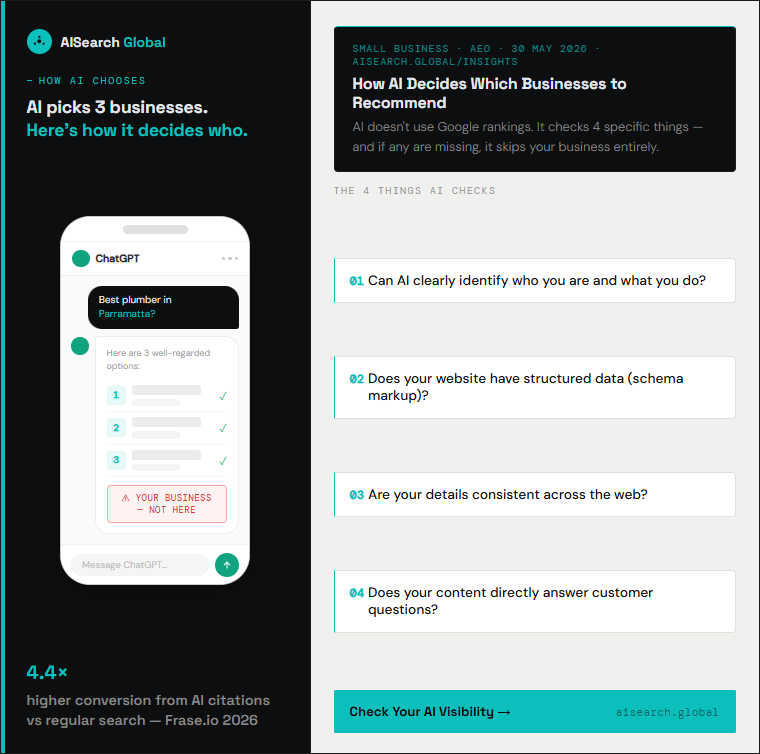
When someone asks ChatGPT or Claude "best plumber in Parramatta" or "top accountant near me" — AI doesn't show them a search results page. It picks 3 businesses and names them directly. This is how it decides who those 3 are — and what you can do to be one of them.
First — understand what AI is actually doing
When you type a question into Google, it returns a list of websites. You pick one and visit it. That's how search has worked for 25 years.
AI works differently. When someone asks ChatGPT or Claude a question, the AI constructs an answer from everything it already knows. It doesn't send the person to a list of websites. It gives them a direct response — and if they asked for a business recommendation, it names 2 or 3 businesses directly in that response.
The person asking gets names, not links. They often never visit a search results page at all.
This means your Google ranking doesn't help you here. A business that ranks #1 on Google but has a poorly structured website will be skipped by AI entirely. A smaller competitor with clean, structured data will be recommended ahead of them every time.
The 4 things AI checks before recommending a business
AI platforms don't guess. When they evaluate whether to recommend your business, they look for 4 specific things. If any of them are unclear or missing, the AI moves on to the next option.
AI needs to unambiguously know your business name, what you do, where you're based, and who you serve. If your website says something vague like "quality services across the greater Sydney region" — that's not enough. AI needs specifics. Plumber. Parramatta. Residential and commercial. That's what it's looking for.
What to fix: Make sure your homepage and service pages clearly state your business name, trade or service, and suburb or city in plain language. No fluff.
Structured data (also called schema markup) is a small piece of code added to your website that tells AI systems exactly what your business is. Without it, AI has to guess your details from your website text — and if it's not sure, it skips you.
Think of it like this: Google Maps needs your address entered correctly to show your location. Schema markup is the same idea — it tells AI exactly where to find your information and what it means.
What to fix: Add schema markup to your website. It's a technical job but a one-time fix — and one of the highest-impact changes you can make for AI visibility.
AI doesn't just look at your website. It cross-checks your business against directories, review platforms, social media profiles, and industry listings. If your business name is slightly different on Google Maps vs your website vs your Facebook page — AI loses confidence in you and moves on.
What to fix: Check that your business name, address, phone number, and service description are identical everywhere they appear online. Same spelling. Same format. Every time.
AI platforms are built to answer questions. They naturally prefer websites that are also written to answer questions directly. If your website is full of marketing language like "we pride ourselves on quality and reliability" — AI can't extract a useful answer from that.
Compare that to a page that says: "We provide emergency plumbing services in Parramatta, available 24 hours, 7 days a week." That's a direct answer to a direct question. AI can use it.
What to fix: Add a FAQ section to your website that directly answers the questions your customers actually ask. Write your service pages so they answer specific questions, not just describe you.
A practical example — two plumbers, one gets recommended
Here's how this plays out in real life. Say two plumbers both operate in Parramatta. Both have been in business for 10 years. Both rank on Google.
Plumber A has a website built in 2018. It says "serving Western Sydney with quality plumbing services." No schema markup. Their Google Maps listing says "Western Sydney Plumbing Co." but their website says "WS Plumbing." Their Facebook says "Western Sydney Plumbing."
Plumber B has a similar website, but they've added schema markup that clearly states they're a plumber in Parramatta. Their business name is identical everywhere. They have a FAQ page that answers questions like "Do you do emergency call-outs?" and "Do you service Parramatta and surrounding suburbs?"
When someone asks Claude or ChatGPT for a plumber in Parramatta — Plumber B gets recommended. Plumber A doesn't exist in the answer.
It doesn't matter that Plumber A has been in business longer. AI recommends whoever it can most clearly understand and verify.
Only 20% of businesses have started working on this. That means if you act now, you're ahead of 80% of your competitors in your category — including businesses that have been operating for years longer than you.
What you can do this week
Open ChatGPT or Claude. Type "best [your trade] in [your suburb]." See if your business name comes up. This tells you your current AI visibility position right now.
Google your business name. Make sure your name, address, and phone number are identical on your website, Google Maps, Facebook, and any directory listings.
Write 5 questions your customers actually ask — and answer them directly and specifically on your website. This is the fastest content change you can make for AI visibility.
We run a non-invasive check across ChatGPT, Perplexity, Gemini, Claude, DeepSeek, and Grok and show you exactly where you appear and where you don't.
Common questions
AI evaluates four things: whether it can clearly identify your business, whether your website has structured data (schema markup), whether your details are consistent across the web, and whether your content directly answers questions. Businesses that score well across all four are the ones that get recommended.
Google rankings and AI recommendations use completely different criteria. Google ranks pages by authority and keywords. AI recommends businesses based on how clearly it can extract and verify your information. A business with a simpler but well-structured website can appear in AI answers before a larger competitor whose site is hard for AI to read.
Schema markup is code added to your website that tells AI systems exactly what your business does, where you operate, and who you serve. Without it, AI has to guess — and if it's not sure, it moves on. It's one of the fastest and highest-impact AEO improvements a business can make.
Schema and structured data improvements can start making a difference within weeks. Building consistent citation signals across directories takes a few months. The businesses that start now are the ones that will be hardest to displace once their competitors catch on.
No. The changes happen at the structured data and content layer — adding schema markup, adding a FAQ section, and making sure your business details are consistent across the web. These work on top of your existing site without a redesign.
Check Your AI Visibility
We run a non-invasive check across ChatGPT, Perplexity, Gemini, Claude, DeepSeek, and Grok — and show you exactly where your business appears and where it doesn't.
Request a Free Visibility SnapshotReferences — Data as at 30 May 2026
- Frase.io (2026). AI-driven visitors convert at 4.4× the rate of standard organic visitors. frase.io
- LLMrefs (April 2026). AEO Complete Guide 2026 — citing SparkToro zero-click search data. llmrefs.com
- CXL (May 2026). 70% of organisations believe AEO will significantly impact digital strategy within 1–3 years; only 20% have begun implementing it. cxl.com
- Ahrefs (December 2025). Position-1 CTR drops 58% when a Google AI Overview is present. Cited via frase.io