
Trust Transfer: Why I Wrote a Book That Puts the Trustor in Control
Trust Transfer is a free book that explains how trust moves from something you already know, across a connection, to something you do not. I wrote it to protect the person doing the trusting. Most trust thinking is built to help organisations win trust. This one gives the reader the checks, and gives organisations a way to repair trust that was lost.
Trust Transfer is a free 192-page book I wrote about how trust moves. A friend recommends a café, so you trust the café a little before you have eaten there. A badge, a ranking, a famous name or a fluent AI answer does the same job at a larger scale. The book gives you a way to see what that connection really carries before you lean on it.
What the book is about
The model has three parts and one reader.
- Source: the thing you already know and trust. A friend, an expert, a brand, a regulator, a platform.
- Bridge: the connection between the Source and something less known. An endorsement, a certification, a ranking, an integration, a proxy or simply appearing next to a trusted name. The book sets out six of these forms.
- Target: the person, product, claim or system that receives the confidence.
- The Trustor: you. The person reading the connection and deciding how much risk to accept.
The central question is one you can ask in a few seconds: what does this connection genuinely give me a reason to believe?
TRUSTOR
The person or group deciding whether to accept Vulnerability
Eye of the Trustor: the bounded perceptual lens, present at every link, not a step
Transfer: the movement of trust →
Borrowed Confidence is not a mistake. Nobody can check every product, institution or system from scratch, and the book says so directly. The mistake is letting a connection carry more than it was built for: reading a badge as a guarantee, a ranking as a recommendation, a famous name as a warranty, or a fluent answer as a checked one.
| Bridge form | What the Bridge appears to say | The question to ask |
|---|---|---|
| Endorsement | "The Source recommends or vouches for this Target." | What did the Source actually review, and on what basis? |
| Certification | "A recognised body attests that the Target meets a stated standard." | Which standard, scope and period does the certification cover? |
| Ranking or Placement | "The Target has been surfaced above alternatives." | Is the position based on quality, relevance, popularity, payment or another criterion? |
| Embedding or Integration | "The Target appears within or through a trusted product, service or workflow." | What does inclusion mean: validation, procurement, compatibility or simple availability? |
| Proxy | "An intermediary has selected, screened, represented or acted for the Target." | What authority does the intermediary have, and whose interests does it serve? |
| Co-presence | "The Source and Target appear together in a context that seems meaningful." | Is the association substantive, limited, incidental or manufactured? |
Table 1. The six Bridge forms and the question that tests each. From Trust Transfer, Table 2.1.
The chapters then work through that idea in turn. One person to another. A famous name lending itself to a product. Many voices that may be one echo. Why a connection has a time condition and what a repeated claim is worth. Brands and influencers. Platforms, search and algorithms. Machines we never inspect. What happens when the Target proves itself, or does not. How doubt spreads backwards, forwards and sideways when a connection fails. How to respond: contain, repair, monitor. How to design a trust signal that does not overclaim. How a whole market keeps its verifiers honest. A one-minute field guide for the reader. And a last chapter on whether trust can transfer to AI at all.
Why I wrote it
I wrote it to protect the Trustor.
In my reading, most trust frameworks are built for marketing agencies and branding consultants. They describe how to move the customer along, which makes the customer the target at the end of the chain. I wanted the control back in the Trustor's hands.
There is a great deal of information in the world. People need frameworks that let them decide what to trust and how to trust it. They also need a way to repair trust once it has been broken, and the book includes one for organisations as well.
It is not only a framework for my business. It is the one I use for my life, and everything I build on my sites and in my work rests on it. Users and customers need the power to decide. They should not be the target at the end of someone else's framework.
Auditability matters most to me. You should not trust a person or a thing because it says "trust me" or "believe me". It should earn that trust, and you should be able to check how.
What changed between the first paper and this edition
The earlier version is a working paper on SSRN. It followed the established trust literature and put the Trustor at the end of the chain: Source, then Bridge, then Target, then the person who decides.
That placement never sat right with me. The Trustor does not arrive at the end. The Trustor decides what counts as a credible Source, how a Bridge is read and how much risk to accept, from the first link onwards.
So in this edition I call that the Eye of the Trustor, and it runs the whole way through. It sits inside the model's logic but outside its sequence. That one change moves the reader from the last box of the diagram to the centre of it. In the finished model the same Eye also reads what a Target does afterwards, which is how trust comes to be earned, lost or left undecided.
DIRECT EVIDENCE AND THE OUTCOMES
The Eye of the Trustor stays present at every link
↓
↓
Four checks you can use today
Chapter 16 is a field guide for the reader. These four checks come from it and from the chapters before it, and the book states where each one stops being reliable.
- Name the chain. Say it out loud: X is vouching for Y, through Z.
- Ask what the connection certifies, and as of when. A five-star average says reviewers were satisfied. It does not say the product is well made.
- Check how much is at stake. Slow down when a decision is expensive and hard to undo. For small decisions, a few seconds is enough.
- Run the Bridge-Removal Test. If you had never received the original introduction, would what the Target has shown since still justify relying on it? If yes, the Target has earned it. If not, the introduction is still doing the work.
The book also offers a one-page decision sheet for organisations to fill in before relying on a supplier, a partner, a platform or a badge, and again if something goes wrong.
A worked example: a founder deciding whether to trust AISearch Global
The fairest test of a framework is to point it at the person who wrote it. So here is the chain run on AISearch Global, from the seat of a solo founder who is deciding whether to book a Founder Audit. Treat it as an illustration. I am applying my own model to my own business, so check each line yourself.
Name the chain. Say a friend, or an AI assistant, mentions AISearch Global. The Source is whoever mentioned it. The Bridge is the recommendation. The Target is AISearch Global. The Trustor is the founder, and the founder decides what counts as a reason to rely on it.
| Question | The founder's answer, using the book's checks |
|---|---|
| What is the Bridge? | An endorsement. Ask what the friend actually reviewed. If they have not used the service, the recommendation is testimony, not Direct Evidence. If an AI assistant named us, the Bridge is a ranking inside a fluent answer, and the book's point applies: it does not show which sources were weighted. |
| What has the Target shown directly? | Nine free checks run on the founder's own website at the Free Check, with email optional. That is evidence the founder generated, not borrowed. |
| What does the Target publish about itself, with its limits? | Our own site is the Client Zero case study, which reports a 100/100 structural score and 16% visibility in AI answers. The gap is the point: a clean score does not mean AI names you. The case study is Client Zero Update: 100/100 Structural, 16% Visible. |
| How much is at stake? | The Founder Audit is a flat $1,500 AUD, one-off. That is real money for a solo founder, and it cannot be un-spent, so the stake is moderate and not small. This is the kind of decision the book says deserves more than a few seconds. |
| What is the audit itself made of? | Fifty dated observations (five AI surfaces, ten prompts each), so the founder can see the date and the answer, and re-run the same prompt later. It does not promise a ranking or a result. |
| Does the Bridge-Removal Test pass? | Not yet, and that is the honest answer. Before any work, the evidence is the free checks and the published case studies. After the audit and the 30-day recheck call, the founder can ask the test properly: if nobody had recommended us, would what we showed them still justify relying on it? |
What the worked example shows is that the framework gives the founder things to do, and gives us things to prove. We cannot ask you to trust us because we say so. We can give you the dated observations, the checks you can re-run yourself, and the limits of what we found.
The same chain, pointed at an AI answer. The other half of our work is the reverse case. A customer asks an AI assistant for a business like yours, and your name is missing or someone else's is there. For that customer, the answer is a Bridge: a fluent, compressed summary that may or may not be right. The audit's job is to turn that single answer into Direct Evidence about the AI system: the same question, asked on five surfaces, on a stated date, written down. That is the Founder Audit, described in the book's terms. It does not make an AI answer trustworthy. It lets a business owner see what the Bridge is carrying today and check again later.
What ChatGPT said when we tested it
Insights articles here carry real AI answers, so on 21 November 2026 I asked ChatGPT two questions, logged out and with web search on. Both are saved with the full text and screenshots.
Test 1: a question about the book. I asked, "What is the book Trust Transfer by Viveka Mohan Das about?" ChatGPT found the book and got a lot right: it is free, 192 pages, 2026, published by Mindful Machines Press, and a synthesis rather than a fully validated theory. It also got the framework itself wrong. It wrote the chain as "Source → Relationship → Target → Transfer", with four boxes. The book's chain is Source → Bridge → Target, read by a Trustor, and Transfer is the movement of trust, not a fourth box.
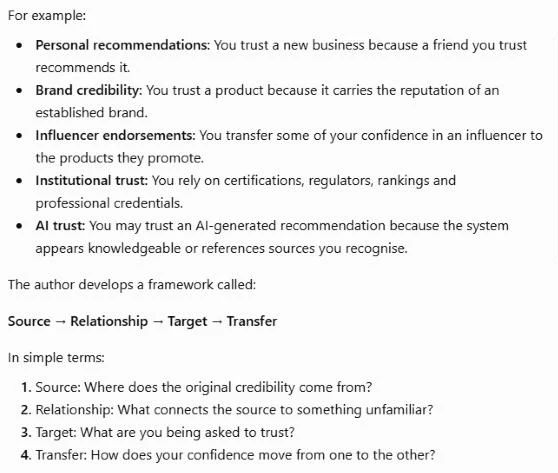
That is the book's own argument in miniature. The answer was fluent, mostly right and easy to believe, and the one detail it changed is the central idea. A fluent answer is not a checked one. If a reader had taken the "Relationship" version, they would have lost the question the Bridge is there to prompt: what is this connection actually carrying?
Test 2: a question a customer would ask. I asked, "I run a one-person business in Australia. Who can help me get my business named in AI answers like ChatGPT?" ChatGPT explained GEO and AEO, gave a shortlist of other Australian providers and a rough price table, listed five questions to ask before hiring, and warned that nobody can guarantee a recommendation. AISearch Global was not named. It called its own list "a shortlist to investigate, not a verified ranking of results", which is a fair thing for an AI answer to say about itself.
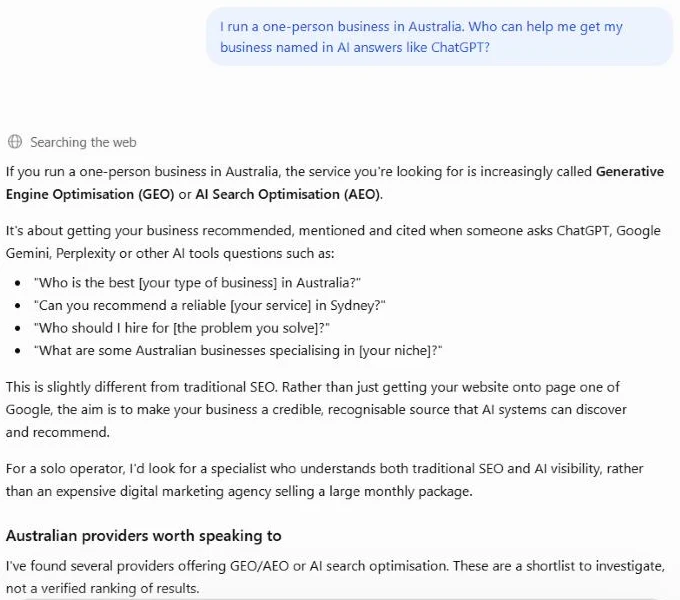
I am not reading anything into that gap beyond what it shows: on one day, for one wording, ChatGPT did not name us. That is the Bridge a founder meets before they ever see our site. It is also exactly what the Founder Audit records, with dates, so a business owner can check it again later.
Why this matters for AI search
Chapter 8 treats search results and AI answers as Bridges. A ranking turns an order into a meaning. An answer box compresses the link between a source and a claim. The book's own summary of an AI-generated answer is that it is a fluent, compressed synthesis that does not establish which sources were weighted or that it is correct.
Chapter 17 asks whether trust can transfer to AI at all. It reports a gap between use and trust: in a 2025 University of Melbourne and KPMG study, 66% of people globally used AI and 46% were willing to trust it. For Australia, the same study found 36% willing to trust. The book is careful about what these numbers do and do not show. They compare groups of respondents at one point in time. They are not a measurement of one person's trust moving from a source to a machine.
What people said would raise their trust points to checks they can see: the right to opt out, accuracy monitoring, a human able to override, laws, and independent audit. That is the book's reading, offered as an interpretation.
What the book is not
It is a synthesis. By "unified" I mean one organising way of seeing and checking, not a theory I have tested. Several ideas, including the Bridge-Removal Test and the scorecards, are my own proposals, and the book labels them as diagnostic aids rather than validated measures. A companion volume will look at what AI changes about the model.
Parts of the book were drafted, edited and structured with the help of AI tools. The framework, the arguments and the conclusions are mine.
Get the book
Trust Transfer is free to download from the Trust Transfer page. It is published by Mindful Machines Press and all rights are reserved. To cite it: Mohan Das, Viveka (2026). Trust Transfer: A Unified Theory of How Trust Moves Through Networks, Brands, and Institutions. Mindful Machines Press.
Frequently asked questions
What is Trust Transfer?
Trust Transfer is a free book by Viveka Mohan Das about how confidence moves from something you already know, across a connection such as a badge, ranking or recommendation, to something you do not. It gives the reader checks for deciding how far to rely on that connection.
Who is the book for?
It is written for the person deciding what to trust, such as a customer, a buyer, a reader or an employee. It also offers a decision sheet and a repair sequence for organisations that want to design honest signals and recover from a failure.
What changed from the earlier working paper?
The first paper placed the Trustor at the end of the chain. This edition moves the Trustor to the centre as the Eye of the Trustor, which reads every link from the Source through to the Target's own record.
Is Trust Transfer a tested theory?
No. The book describes itself as a synthesis and a way of seeing and checking. It applies the model to examples and labels its own proposals as diagnostic, not validated.
Is the book free?
Yes, it is free to download. All rights are reserved, so please cite it rather than reproduce it.
Next step
- Run the Free Check. Nine free checks on your own URL. Open the Free Check.
- Or get the Founder Audit. $1,500 AUD, with 50 dated observations across 5 AI surfaces, targeted fixes and AI prompts to get your AI to help you make them. See the Founder Audit.